
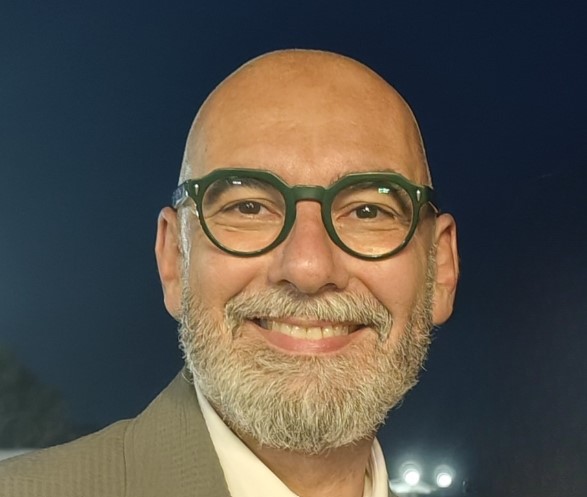
Gabriele FICHERA
Gabriele Fichera was born in Catania on October 3, 1973.
He earned a Master’s degree in Mechanical Engineering from the University of Catania in January 1998, graduating with highest honors (summa cum laude). He subsequently carried out a one-year research internship at the Fiat Research Center (Turin), within the Vehicle Division, focusing on vibrational dynamics and vehicle handling.
In 2001 he received his Ph.D. in Structural Mechanics from the University of Catania, where he is currently a tenured Researcher. For more than ten years, he has also been a lecturer in Modeling and Simulation of Mechanical Systems and Vehicle Dynamics within the Master’s Degree Program in Mechanical Engineering.
His scientific activity mainly concerns the dynamics of discrete and continuous mechanical systems, studied through advanced numerical modeling techniques (multibody systems, finite elements, CFD) and through various identification and optimization methodologies (neural networks, experimental modal analysis, etc.). His research focuses particularly on road vehicles, with emphasis on both handling behavior and ride comfort. He maintains active research collaborations with vehicle manufacturers and companies developing software for vehicle dynamics simulation for driving simulators.
He is the author of numerous scientific publications in international journals and conference proceedings.
The research activity is mainly carried out in the following fields:
-
Handling and NVH of road vehicles
-
Multibody system dynamics
-
Mechanical vibration and noise control
-
Driving simulators
Some of the topics currently under investigation include:
-
Elasto-kinematic characteristics of road vehicle suspensions
-
Ride comfort and handling of modular-structure vehicles
-
Ride comfort assessment in vehicles with suspended mechanical frames
-
Multi-objective optimization applied to ride comfort and handling
-
Numerical and experimental evaluation of ride comfort in intercity buses
-
Real-time simulation of vehicle dynamics
-
Driving simulators for handling and NVH
-
Vortex-induced vibrations in underwater structures
-
Analysis of braking in different types of vehicles and the blanking phenomenon in motorsport